
Social Media and Community Management for Startups: Part 2
Last week, I wrote an overview of Community Management for Startups, explaining why community management can become an important part of a business’s evolving success as it grows; particularly if it grows very fast. Today, we’re going to take a deeper look at just one aspect of Community Management: growing your community on and off social media.
How Facebook and Twitter Work: In Theory

If you’re a startup that’s offering a SaaS platform, a consumer product, consumer content, or any other service, you should probably be familiar with the Pareto Principle. Named from an early 20th century Italian economist who observed that 80% of the land in Italy was owned by 20% of its population, the principle states that this 80/20 distribution, or “the principle of factor sparsity,” roughly reflects the total activity in a system, in proportion with its most active users.
For example, if you have 100 Facebook friends, then you can expect that about 80% of the content shared, messages sent, and likes and shares executed among your Facebook friends, will be the work of just 20 of those friends. A similar distribution is common in many economic and commercial fields. For example, most companies can expect that 80% of their profits are generated by 20% of their customers. Likewise, about 80% of a company’s productivity is generated in just 20% of its employee’s working time.
Corollaries to this rule, as applied to social networking by blogger/entrepreneur Andrew Chen and others, are the 1/9/90 principle, and the Metcalf Principle, which state respectively that within any content platform, for every 1 creator of content, 9 will interact with the content, and 90 will view it, and that the value of a network is proportional to the square of the number of users. However, this is an average, and doesn’t account for the relevance of content to the users- some content is highly sharable, and other content is worthless.
Facebook somewhat complicates this situation by applying an algorithm to its feed content, which preferences those who are more likely to be engaged with a particular post. This raises the chances that people will view it, but lowers the possibility that you will reach someone who has not expressed interest in something similar before. Effectively, Facebook artificially raises the value of the users in its networks by preferencing connections which are more likely to lead to interaction.
This is something that Twitter does not do (as much), and it is a major point of departure between the two. With Twitter, the Metcalf Principle- the idea that the value of a network scales exactly according to its size, as applied to the whole platform, and to networks inside it, is valid. With Facebook, the size of the network is still important, but Facebook is playing from both ends: anticipating what users want to see, while limiting the number of users that a publisher can reach by default (which happens to be about 16%, again on average). This makes individual impressions theoretically more valuable, because they should be more relevant, while making overall virality (proportional to the total network load) less important, and the appearance of virality almost completely unimportant. This has allowed Facebook to develop a much more valuable ad platform than Twitter has managed, and this is partly because Facebook has kept individual users more actively engaged in multiple “networks” at the same time, accessible to many different layers of advertising and influence. Facebook isn’t for single issue accounts -something that Twitter thrives on- meaning that Facebook can foster more connections and more network value out of individual users.
Here’s What That All Means
In essence this all means that the rules for building a base of users for your platform/content/service, and the rules for building a community on social media are similar, but slightly different. The rules are also different on different platforms. When building a base of users, you need to understand that your highest value users, the ones who contribute 80% of the money you make, could represent just 20% of the total. However, an early mistake that many startupers make is to assume that the rules for growing a social media presence, and growing their base of users, are the same thing- they see value in the number at the top of the page, assuming that 1000 users is always 10 times better than 100.
But network effects on Social Media are far more complicated than they are in a closed product platform. For starters, a single influencer in your network can be more influential on his/her own than your entire network is without them. This is particularly true on less controlled platforms like Twitter- which is the attraction there for celebrities, tycoons, and those that wield huge personal and brand networks. StartupYard may have over 2000 followers, but if just one of those followers is Richard Branson, Jack Dorsey, or Elon Musk, then powerful network effects can come into play.
The situation is even more complex on Facebook, where network effects are not directly visible- no single user can see how many times a post has been shared or liked across all possible networks on the platform, because the platform doesn’t show users information not relevant to networks they are directly connected to, affecting people’s interaction with content. On Twitter, the network effect is a part of the story: tweets are famous because they’re famous. On Facebook, virality is distilled more purely into that which attracts interaction, generating more interaction, and being selectively promoted for that reason alone.
Putting it in Action
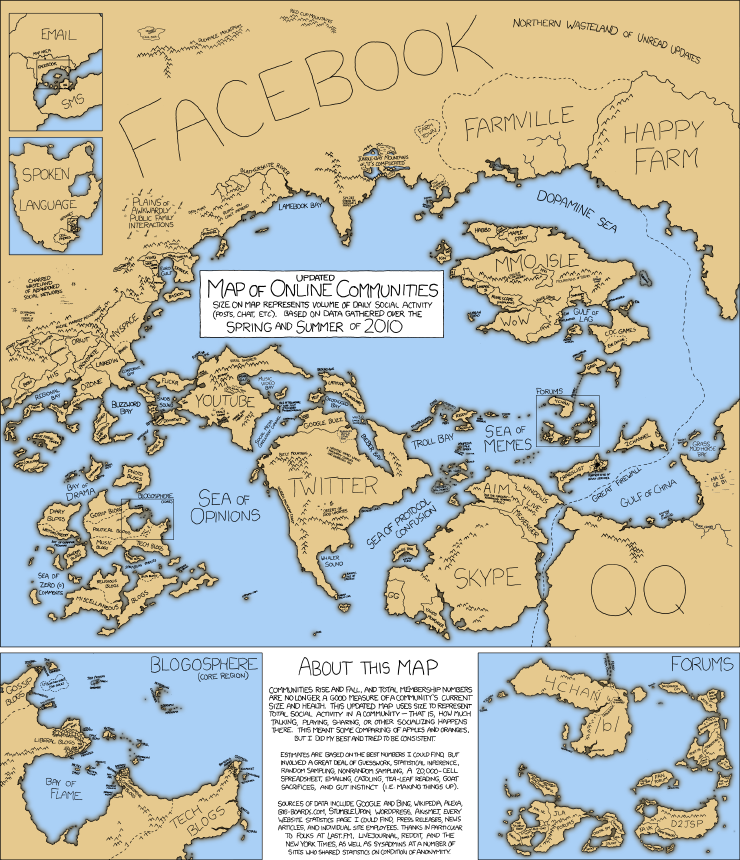
Knowing all of this is good. And I recommend reading through more of Andrew Chen’s amazing work on the subject to get a better understanding of the theory behind social media marketing. But here are a few of the actionable insights you can apply to building your network:
1. Do NOT focus on the Vanity Statistics
StartupYard isn’t a product company. We don’t make anything (unless you consider Startups a product, and we don’t), and we don’t provide a service directly to the public. Nothing we do is for sale. So the idea that we need a huge network on Twitter should seem deeply silly to us. But like all slaves of fashion, we find ourselves becoming concerned with that number at the top of the page. Why isn’t it higher? Why is it lower today than yesterday? Is it growing fast enough?
These questions can distract us from the actually important data. How many people are reading our posts? Are we getting retweeted and favorited? Is our network growing in quality, as it grows in quantity? Are we following and being followed by valuable contacts? Despite not having thousands of followers, our posts are regularly clicked on by up to 7% of our followers. That’s a pretty damn good number on Twitter.
If what you’re interested in is being heard, and being noticed, not by anyone, but by the right people, then you should be willing to trade 1000 Twitter followers for one follower, if that person has a network of high enough quality him or herself. So focusing on the right networks within social media is key to a successful strategy.
Invest some time in products like FollowerWonk that allow you to analyze social networks, and identify key influencers, focusing your efforts on capturing the attention of their networks. People on social media are ultimately looking for what is of value to them. So finding networks that have already coalesced around shared values is going to work better than trying to create them from nothing. What are they talking about? What interests them? And what do you have to say about that? This isn’t rocket science, but it’s not sales either. Don’t treat Twitter and Facebook like you would email marketing. It’s not the same at all.
- Watch Your Networks
There are many ways to monitor and be on top of your social media networks. And this effort goes hand-in-hand with understanding what people are concerned with, and talking about on different platforms, and in different communities. Hootsuite, and TweetDeck are popular for monitoring and managing multiple accounts at the same time, while BufferApp, and lesser known, but beautifully executed Scoop.it, are designed to help you find, curate, and share relevant content to your networks, staying a part of the overall conversation, even when you aren’t on hand to participate directly.
Social media scrapers and analytics companies like Scoop.it or BuzzSumo will also help you identify which content is being shared accross social media networks- information that isn’t always as apparent on the platforms themselves- particularly Facebook. It will show you which posts in your field of interest are popular, and on which networks, and it will grow to focus more and more on the networks that are relevant to your interests, and those of your followers.
- Automate Your Network: But Not For Evil
Now hang on. Don’t be that guy. Don’t set up automatic direct messages to everyone who follows you, and don’t follow back every bot that follows you either. Let’s all calm down.
There are good and non-evil ways of automating your Twitter network, and making it better. For example, using IFTT, you can automatically gather a list of people who use certain hashtags, and then analyze that list for people who might be interesting to follow on their own, or tweet to, or simply respond to.
You can also use the same service to save lists of people who would be interesting to follow, and by gathering these users in a spreadsheet, you can start to identify which of them are the biggest influencers within their networks, and within your domain as a whole. You can use IFTT or Scoop.it to collect and currate posts by influencers in your network, making yourself part of the conversation. After working with this process for a time, you’ll also be able to anticipate which stories will interest your community, and publish them first, be the first to comment, and write and publish your own blog posts about those topics, as they relate to your products and your company vision. Having your finger on the pulse is just the first step to being a bigger influence on your community.