

Why You Need a Sales Oriented Co-Founder
We already talk a lot about what Andrew Chen calls the product death cycle. The viral chart was created by David J. Bland, but the concept is familiar to many a startup mentor and investor alike. We see it all the time, and no matter how much we try to inoculate our startups against it, its pull is about as powerful as the dark side of the force. It looks like this:
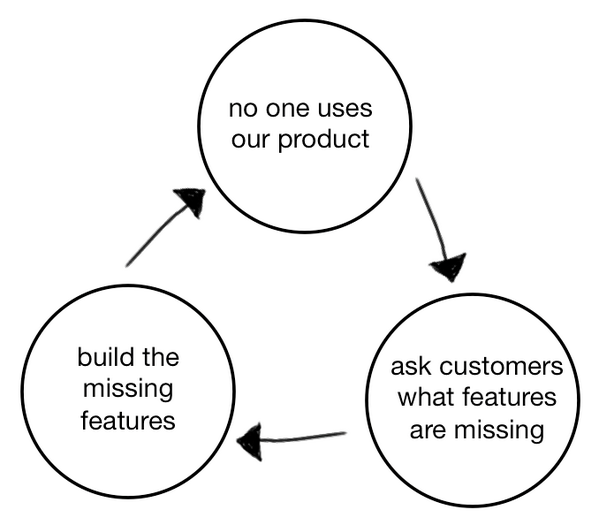
Simply put, people like doing what they know. And engineers are good at solving engineering problems. The narrative for many successful startups also appeals to builders and tinkerers. Ultimately, we like to think of all the greatest startups and tech companies as successful because of their innovations, not because of timing or clever business decisions.
And it’s true that the most successful startups listen carefully to what their customers want. Slack has been a recent test case of a company that is totally focused on delivering exactly what its customers need, and innovating as fast as possible to provide it.
But that only works at the beginning. Early adopters know what they want, and can push you to create a product that is a killer app for them. Later, when more passive adopters are looking for the next obvious solution, your product isn’t necessarily going to be made for them as well. Great startups realize this, and begin the work of convincing a new market to use their products.
In the worst case scenario –and this is one we’ve seen personally more than once– a startup doesn’t even listen to the customers at all. When the product fails to sell or to increase its traction on the market, the founders just innovate new features anyway, hoping that the next feature set will magically do what none have done before, ignoring the fact that their market focus hasn’t really changed at all.
This is all to say, that the very best startups don’t just listen to what their customers want. The very best startups find out what their customers will pay for, and then provide it.
Customer Acquisition-Built In
Troy Henikoff, Director of TechStars Chicago, often says, loosely quoted: “If you hire a salesman to go out and sell something, and he can’t, you fire him. But if a founder goes out and tries to sell, and can’t, you change the product. It’s fundamentally different when the founders have customer acquisition built into their DNA.”
At StartupYard, we have continually had it reinforced to us, just how important this is. After taking on teams because we absolutely loved their vision, their products, and the team themselves, only to see them fail because they simply weren’t willing to be sales-oriented, we’ve learned to be wary of even those companies we are very attracted to initially. No product sells itself, and ultimately, we can’t be in this business for the love of products alone.
A team that is applying to StartupYard asked to meet with me this week. Aside from the fact that I love to see a team so keen, I could tell right away that this was a team that understood customer acquisition. They ostensibly wanted to meet with me to find out more about our program, but it became immediately clear that they were trying to figure out how to get into the program; what they needed to do to be sure they would be accepted.
I don’t mind that in the least bit. Of course, our job is to make sure the team isn’t just saying what we want to hear, but that is the job of any accelerator. The startup’s job is to say what we want to hear, *and* to have it be actually true. So I told them what they could do between now and the evaluation period, which is to prove that they can get customers.
They may not be able to sell anything right now, but traction with customers can come in a lot of ways. Will people sign up for a waiting list? Will they meet to discuss their needs? Will they consult on your product ahead of the launch? Will they recommend colleagues to do the same? There’s a good reason that “talk to 50 potential customers” is such oft-cited advice for startups. You can’t help but learn something by doing it.
And if the startup comes back and says: “well, we talked to 50 customers, but only a few said that this is something they would pay for,” then I would wait and see how they had reacted to that news. Did they find out what the customers were willing to pay for?
Having a Customer Acquisition Focused Co-Founder
Every startup is going to find one or two channels that work best for customer acquisition. The problem is that they will likely not be the first couple of channels the startup tries. An initial strategy may work, at first, for a while, but eventually, the startup is going to have to pivot to something else in order to grow.
Or even worse, a startup may have initial traction because it has a really great product. Then when that traction starts to flatten out, the startup thinks that the problem is that the product isn’t great anymore. In truth, that initial burst has just taken them as far as it can, and it’s time to try something new.
We often get the startups that don’t have a customer acquisition focus, but who did get lucky with some early traction, because the product is really fantastic.
I think back on one startup we worked with. They had a freemium SaaS product that was very popular in app stores, and they had had to do very little marketing to grow into the hundreds of thousands of downloads, and tens of thousands of active users. That’s fantastic. That’s part of why we took that team. And their product is really great. Truly.
But when that growth stalled, this was a team that had never even considered putting together a simple email marketing campaign. They hadn’t been concerned at all with customer acquisition or retention; they couldn’t even tell us their retention numbers. When growth slowed down, they started working on the product again- but lightning doesn’t always strike twice. The app’s initial popularity doesn’t ensure it can continue to grow beyond a certain number of users.
And what we often see is a founding team where nobody is responsible when that happens. This means that everyone on the team can take responsibility for their successes (and they do), but none have to take responsibility for the failures when the product stops selling.
There is little we can do to help startups like this one find religion in the form of focus on customer acquisition. It may not be in their DNA. But if you’re an entrepreneur who is just starting to get the idea that your awesome product may not be quite enough to take the world by storm, take heed: build your founding team, your company’s DNA, with customer acquisition as a focus.
If given the choice between two companies, one of which is comprised of engineers who have hired a sales or marketing manager, and the other with a sales oriented co-founder, we would nearly always choose the latter.
Engineers build. And they make So partner with a sales focused co-founder who will live and die by the numbers (users, engagement, sales, churn) that an engineer doesn’t want to focus on, and has the power in your organization to force changes when those numbers aren’t good. You can’t outsource something that needs to be central to your mission. You need customer acquisition at your core, and you need a sales oriented co-founder.