
Meet CaseLens: The AI Specialized in Complex Disputes
Today we sat down with Aram, CEO of CaseLens to talk more about what they do and his plans for the future.
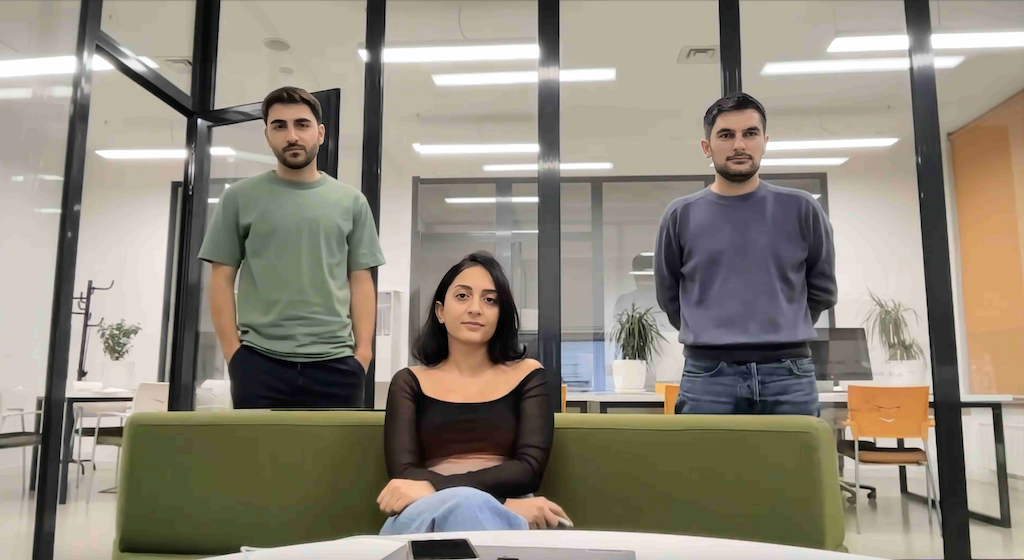
Meet the CaseLens team
Hi Aram, tell us a bit about your personal journey towards founding CaseLens. How did you get here?
I came into law through an unusual route. My first degree was in Statistics, and I spent five years working in IT, running project teams and data teams at large companies, before I ever opened a law book. Then I sat the bar exam, worked in dispute resolution, and moved abroad for a second law degree.
For a long time I treated that path as a problem. Law firms wanted lawyers, not statisticians. But once I started looking at where the legal industry was actually broken, I noticed something. The people trying to fix it were almost never fluent in both worlds. Engineers didn’t really understand how a dispute works. Lawyers didn’t really understand what the technology could do. Sitting in the middle of those two worlds turned out to be the most useful thing about my background, and CaseLens grew directly out of it.
What prompted you to start developing CaseLens? What did you see as fundamentally wrong with the way Legaltech works right now?
My co-founder Aren reached out while he was in the US working at a contract AI startup. He’s a former lawyer too, and we’d both been frustrated by the same things for years. We started by looking at contracts, since that was the world Aren was already deep in and the obvious place to build something.
But the more we dug in, the more we realized the bigger unsolved problem was sitting next door. In disputes, the hardest and most important work is figuring out what actually happened, and the entire industry was still doing that by hand, with software whose only job was to make the manual reading slightly less painful. How do you make sense of a huge, messy pile of evidence in many different formats? Off the shelf AI tools cannot do that. The chatbot and consumer-style interfaces flooding the market right now were never designed for it. So we shifted focus and built CaseLens.
Who is CaseLens for and what problem are you solving?
Our users are the people who live inside large case files. Litigation teams, international arbitration lawyers, forensic experts, arbitrators. The kind of work where the file is not a tidy folder of contracts but a flood of emails, Slack messages, scanned exhibits, video files, sometimes handwritten notes someone photographed badly.
Here’s the thing nobody likes to say out loud. The legal argument is rarely the slow part of a complex dispute. The slow part is figuring out the facts. Roughly 80% of the work goes into reconstructing the chronology before anyone can build a real strategy on top of it. CaseLens is the layer that does that reconstruction. It gives the legal team a clear, organized factual record, with every detail linked back to the document it came from.
You are not the first startup to try solving this problem, and there are already available proven solutions. Why should a company look at CaseLens?
The tools most firms use today were built before modern AI existed, and it shows. They are review platforms. Their job is to make it easier for a person to sit down and read every document one by one. Faster reading, better tagging, nicer windows. At the end of the day, a human is still doing all the real thinking.
CaseLens works from a different starting point. We read every single page. Not as a chatbot waiting for the right question, but as a system that goes through the entire record and surfaces everything the team needs to know. And it doesn’t stop there. We don’t drop a pile of findings on the team and call it a day. We deliver a finished work product the team can actually review, build on, and use.
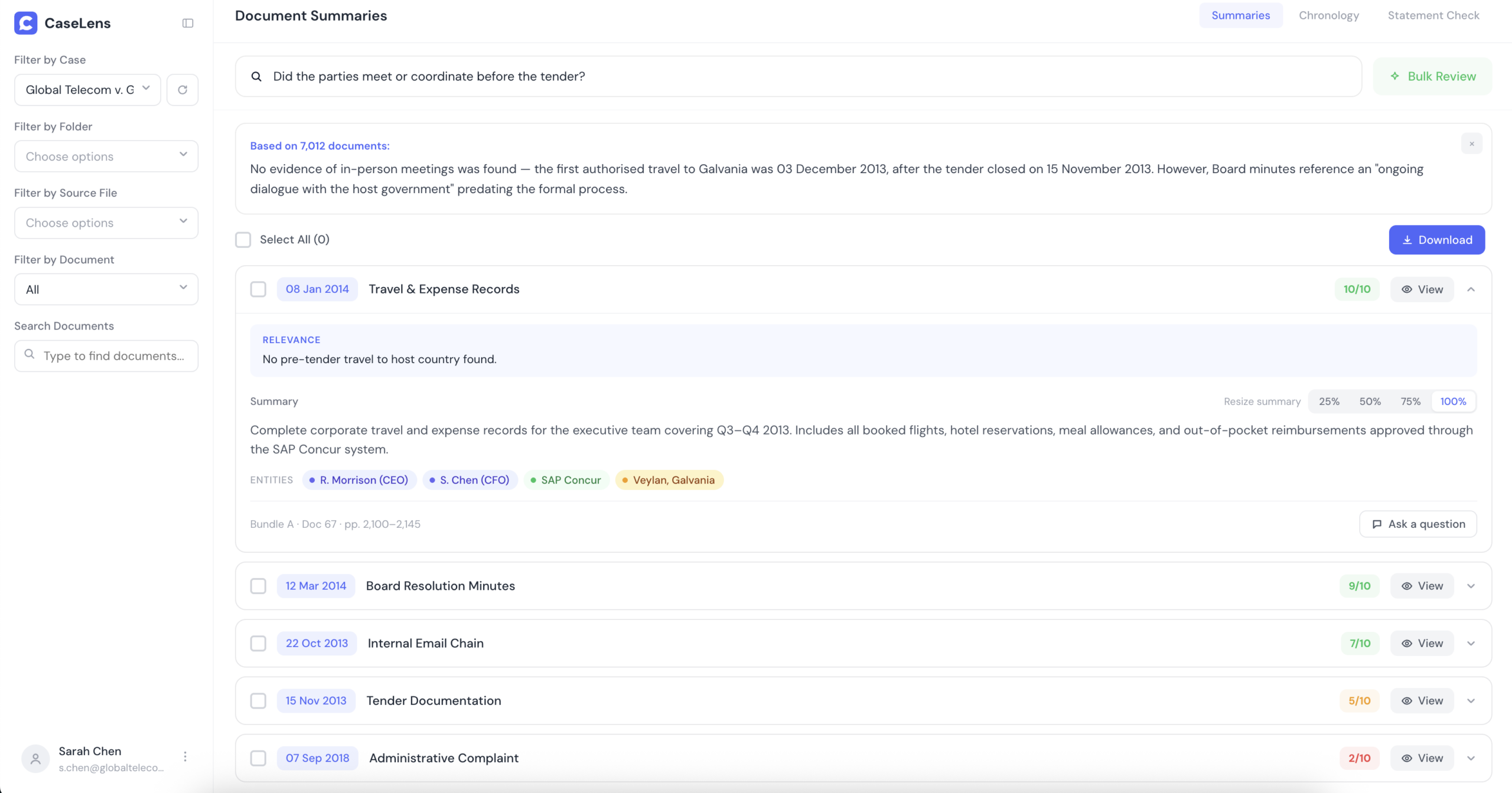
CaseLens – Bulk Review
The other thing that sets us apart is the business model. We are not a subscription legal AI tool. We partner with teams on a per case basis, and that is what makes it possible to actually use AI the way it should be used on a serious dispute. Subscription economics force every product into the same shallow lane. Per case engagement lets us go as deep as the matter requires.
How big is the team and why are they a good match for this project?
The founding team is three people, with seven legal tech companies between us across several countries. Aren and I started the company together, and we brought in Shushan from her own legal tech background to lead design.
I want to explain why design is a real role here and not just a finishing touch. In this kind of work, the way information is presented is how a lawyer decides whether to trust the system. If a lawyer cannot see how the tool reached its answer, they will not use it, and honestly they shouldn’t. Shushan owns that trust.
Let’s talk more about your products. What would you say distinguishes you from other CaseLens solutions? What is your “killer app?”
Most legal AI products today are some version of a chat box. That’s a fine setup if you want to ask questions about one contract. It is the wrong setup for a dispute. A dispute lawyer’s job is not to chat with their documents. Their job is to read the documents at scale, every email, every exhibit, every message, and pull out the picture those documents form together.
So our main product is not a chat box. It is a case dashboard built on top of a full factual record. The lawyer explores the case itself, not the AI. Every fact is sourced, every source can be checked, and the layout mirrors the way disputes actually get built in real life.
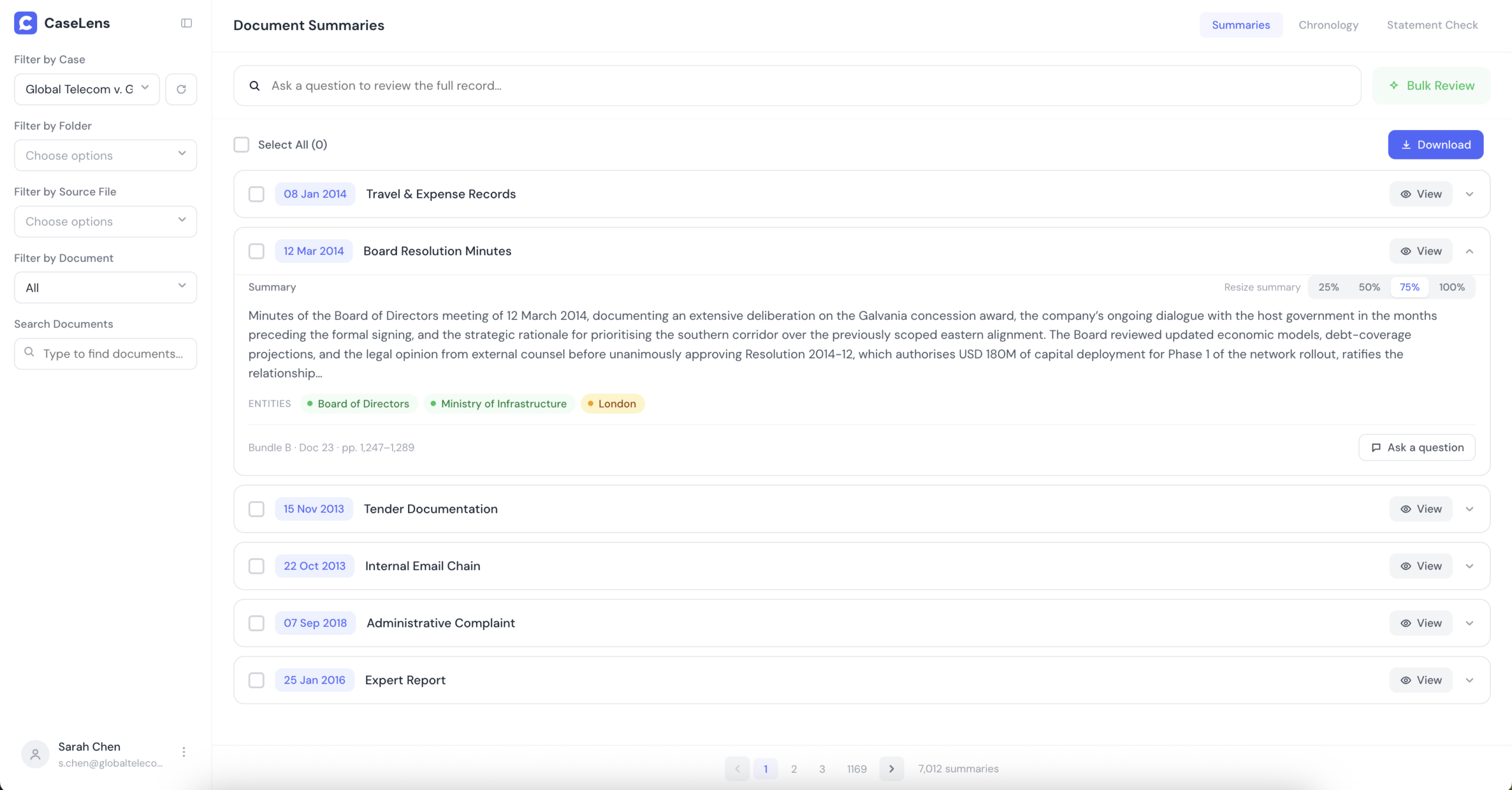
CaseLens – Document Summaries
What are you trying to accomplish with CaseLens that you think no other platform has been able or willing to do?
We are willing to do the expensive, unglamorous work that general purpose tools refuse to do. Building specifically for legal evidence. Designing for the way disputes actually run. Hitting accuracy levels that normal subscription pricing simply cannot support.
That last point is the heart of it. The per case partnership model lets us put real resources behind a single matter, the kind of depth a shared subscription tool will never reach no matter how many features it adds. When the stakes justify it, we can go as far as the case demands.
Can you tell us a bit more about how your technology really works? How unique is your solution?
Here is the honest limitation of today’s AI. These models can read a lot at once on paper, but the part they actually reason about reliably is much smaller. Feed too much in at once and the answers quietly get worse. Every legal AI product runs into that wall eventually.
We go the other direction. We break documents down sentence by sentence and paragraph by paragraph. We give each piece the background it needs to make sense on its own. Then we run the AI over the full set of evidence multiple times, looking at it from different angles. That’s how we catch the things that decide cases. A representation made in a board minute that quietly contradicts a clause buried in a side letter signed two years later. A witness statement that doesn’t line up with that witness’s own emails from the week of the event. A payment instruction in one document that has no matching authorization anywhere else in the record. These are the connections that win and lose disputes, and they are usually invisible to the team reading the file linearly. We pull them out.
What have been your team’s biggest personal or professional challenges in making this project a reality?
The hardest stretch was the year all three of us left steady jobs and worked on this full time, well before we knew the product would work. Building the foundation of a company inside that kind of uncertainty is the real test of whether a founding team holds together. We came out of it sharper and more aligned, but I won’t pretend it was comfortable.
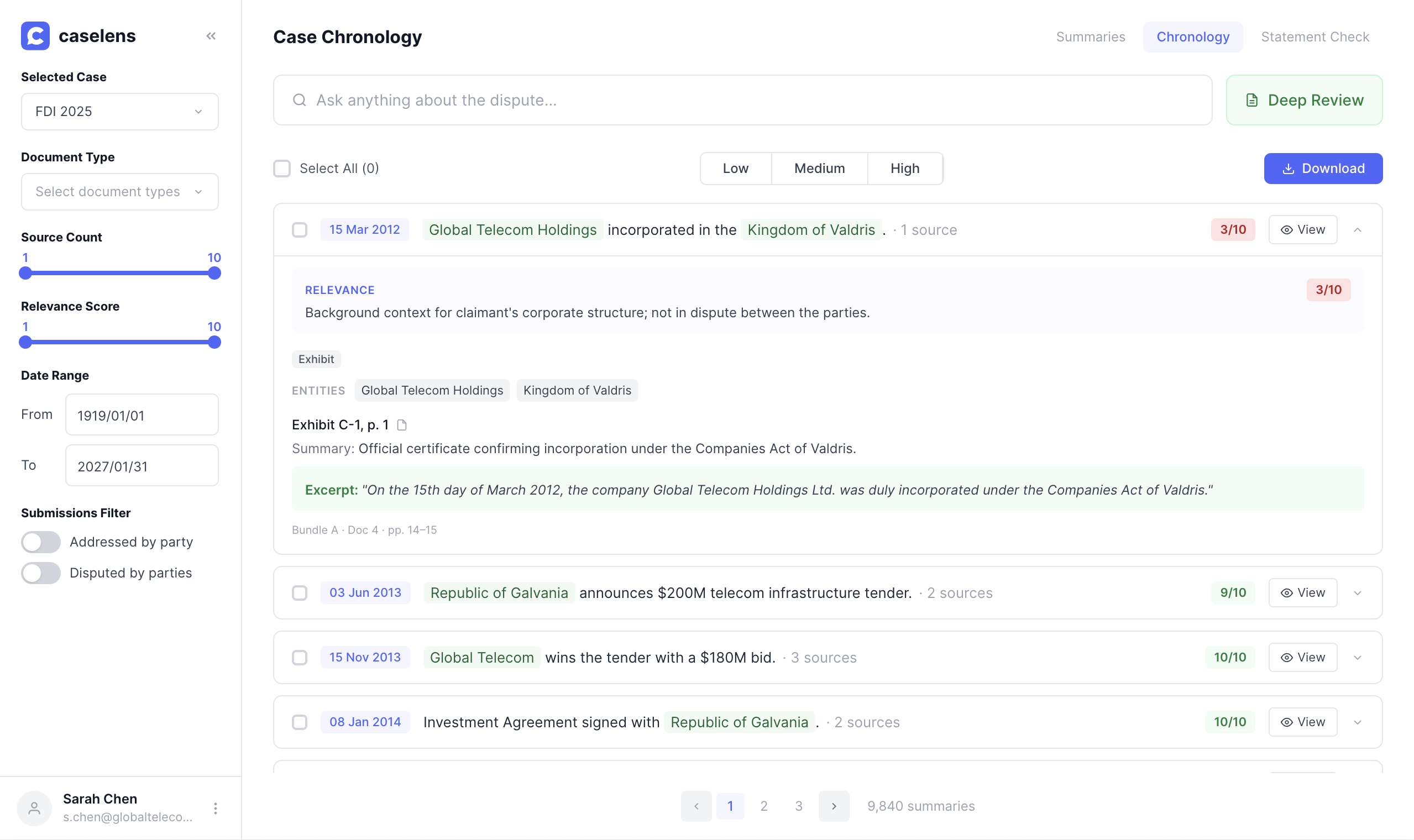
CasLens – Case Chronology
Who is the ideal customer for CaseLens? What do people need to get started with CaseLens?
Anyone who is buried in a large set of documents and trying to make sense of it. In practice that’s outside counsel running complex commercial litigation and international arbitration, expert witnesses preparing forensic and damages reports, in-house legal departments managing disputes from the company side, and arbitrators who need to master a massive record before issuing a decision. The common thread is volume and stakes. When both are high, the manual approach stops working. That is where we come in.
What do you hope CaseLens is going to be in 5 years, as a business or as a technology? What would be your ideal scenario?
Electronic evidence has exploded. Every serious dispute today involves far more material than it did ten years ago, and the tools underneath have not kept up. The five year version of CaseLens is the default backbone for document heavy disputes. The layer that sits quietly underneath every serious arbitration and complex case, handling the factual groundwork so lawyers can spend their time on the parts of the work that are actually theirs. Strategy, argument, advocacy, judgment.
Talk a bit about your experience with StartupYard.
We’ve benefited tremendously from the program. What stands out is that StartupYard actually knows how to help an early stage startup. The advice is built for where you are, not the large company playbook that sounds impressive but doesn’t apply.
The team was hand in hand with us through the hardest parts, always there for the difficult questions. And the program understands the value of introductions and makes them, connecting us with corporates, law firms, and other parts of the ecosystem we would have taken much longer to reach on our own.