Meet Teamsharq: The Platform That Puts a Full Computer in Every Student’s Browser
Today we sat down with Dominik Olszewski, CEO and co-founder of Teamsharq, to talk more about what they do and his plans for the future.

Dominik Olszewski, CEO and co-founder of Teamsharq
Hi Dominik, tell us a bit about your personal journey towards founding Teamsharq. How did you get here?
In 2017 we founded a training company dedicated to helping people reskill and upskill for the modern economy. Over the years we’ve partnered with PwC, Thomson Reuters, Lufthansa Systems, Nordea Bank, Sii, Intel and others. The mission was always the same: learning is not an option anymore. It’s survival.
The economic case is stark. Productivity in wealthy Western countries needs to increase two to four times in the coming decades – just to offset the impact of worsening demographics. For context, US labour productivity grew only 35% across the last twenty years. Immigration won’t close that gap long-term. AI will help, but AI still needs people – people who can do four times more than they do today, who know what questions to ask and how to direct the tools. Even Sam Altman said lately that he and his executives had been “roughly right” on the technological predictions made by OpenAI when it launched ChatGPT in 2022, but they were “pretty wrong” on the social and economic implications.
So the right answer for productivity growth is not only AI, but AI + upskilling. There is no other viable path.
But running technical training at scale has a problem nobody had properly solved: the infrastructure. Every time we delivered a course, a huge amount of time was consumed by environment setup – infrastructure firefighting instead of teaching or IT teams blocking access to external tools. We looked for a solution and couldn’t find one that actually worked. So we built it.
Where does the name come from?
Sharq is a word rooted in Arabic and Persian, meaning “east” – the direction of sunrise, of new beginnings, of light breaking through. When we chose the name Teamsharq, we were thinking about the careers we’d already helped transform: welders becoming software engineers, ex-F-16 fighter pilots pivoting to technology, physicians discovering their potential in the digital world. Team Rising. That’s what the name means and that’s what the platform was built to enable.
Who is Teamsharq for and what problem are you solving?
Teamsharq is for anyone who delivers or manages software-based training: training companies running instructor-led courses for corporate clients, internal learning and development teams at large enterprises building their own upskilling programmes or individual experts sharing their knowledge.
For now, we are supporting instructor-led training, but our goal is to go further: to become the ultimate environment for not only human-to-human meetings, but also an on-demand AI mentor that can not only see what students are doing, but understand the context and take control of existing environments, helping users in real time.
Let’s talk more about your products. What would you say distinguishes you from other education solutions? What is your “killer app?”
Open a browser tab. You get a full Windows or Linux desktop, not a code editor, not a terminal. A real computer, with the software already installed, identical for every learner, ready before the session begins.
Most browser-based learning tools give learners a terminal or a code sandbox. We give them the entire operating system. The browser acts as a monitor: everything the learner sees and does runs in a fully isolated environment on our infrastructure or the customer’s own servers. Nothing is installed on their device. Nothing touches their corporate network. IT security has nothing to block.
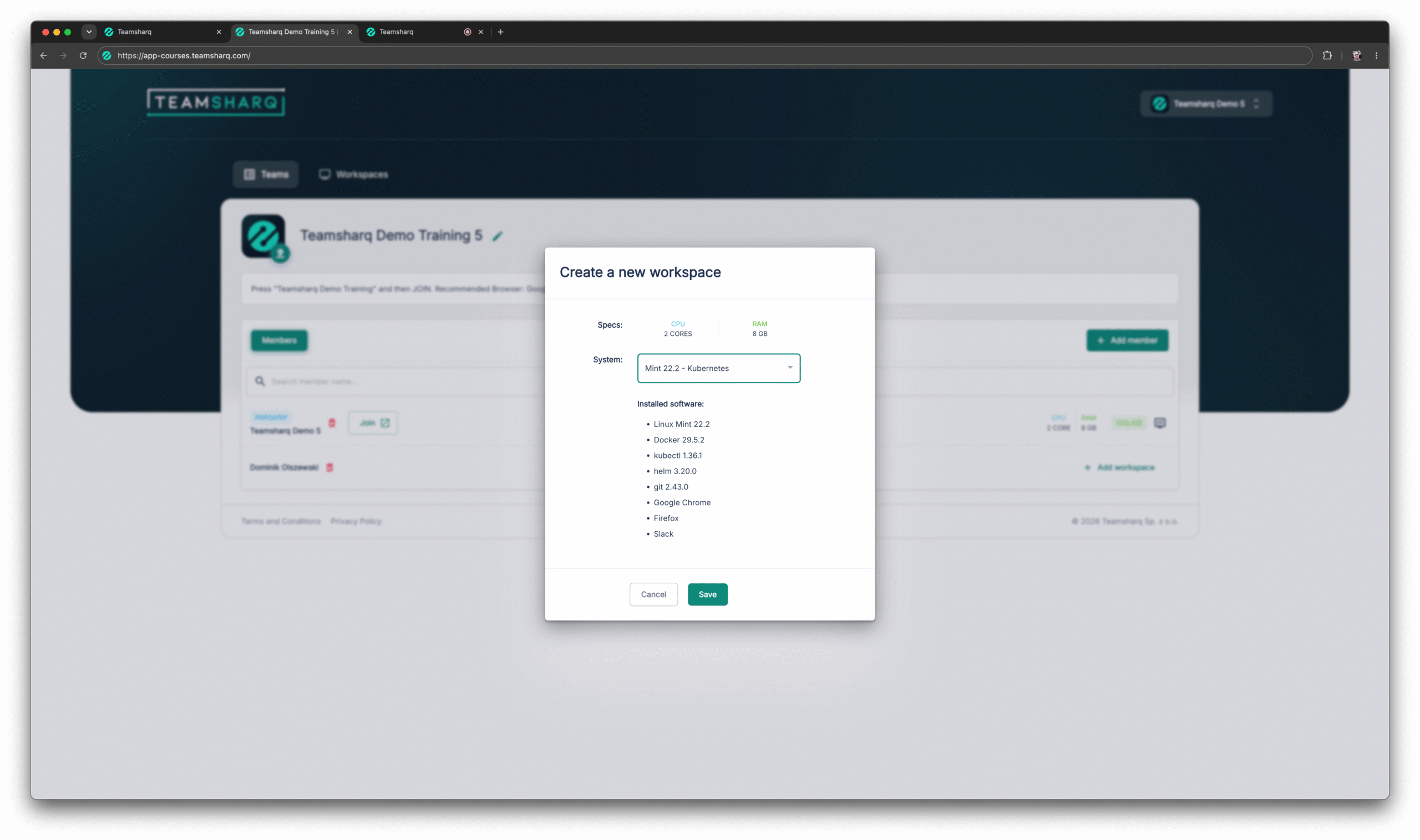
Creating a workspace in Teamsharq
From the instructor’s side, every learner’s screen is visible in real time from a single panel. One click and the instructor is inside that learner’s environment – no screenshare request, no delay. All environments are provisioned from a template, so every learner’s machine is identical. The “it doesn’t work on my machine” problem disappears entirely.
What no other platform has been willing to do is combine full OS access, on-premise deployment and zero IT friction in a single product. Competitors like Strigo and Instruqt are excellent tools but work at the command line. CloudShare is the closest comparison – but cannot be deployed on customer infrastructure. For regulated industries – banking, insurance, healthcare, government – where data cannot go to a public cloud, we’re often the only solution that works.
Is Teamsharq available now and why would a company use it?
Yes, fully available today. Cloud deployments can be up and running within a day. On-premise deployments for enterprise clients take a little longer, but we handle the setup entirely. Pricing is per seat per month for cloud, or a capacity-based licence for on-premise.
Companies use Teamsharq because the alternative is time-consuming. A technical training coordinator at a bank waits weeks for IT approval for a new tool. An instructor loses the first hour of a session to environment troubleshooting. A learner drops off because their corporate laptop blocked the connection. One of our customers told us we’d solved 90% of their training infrastructure problems. That’s not a product feature. That’s a year’s worth of accumulated frustration, resolved.
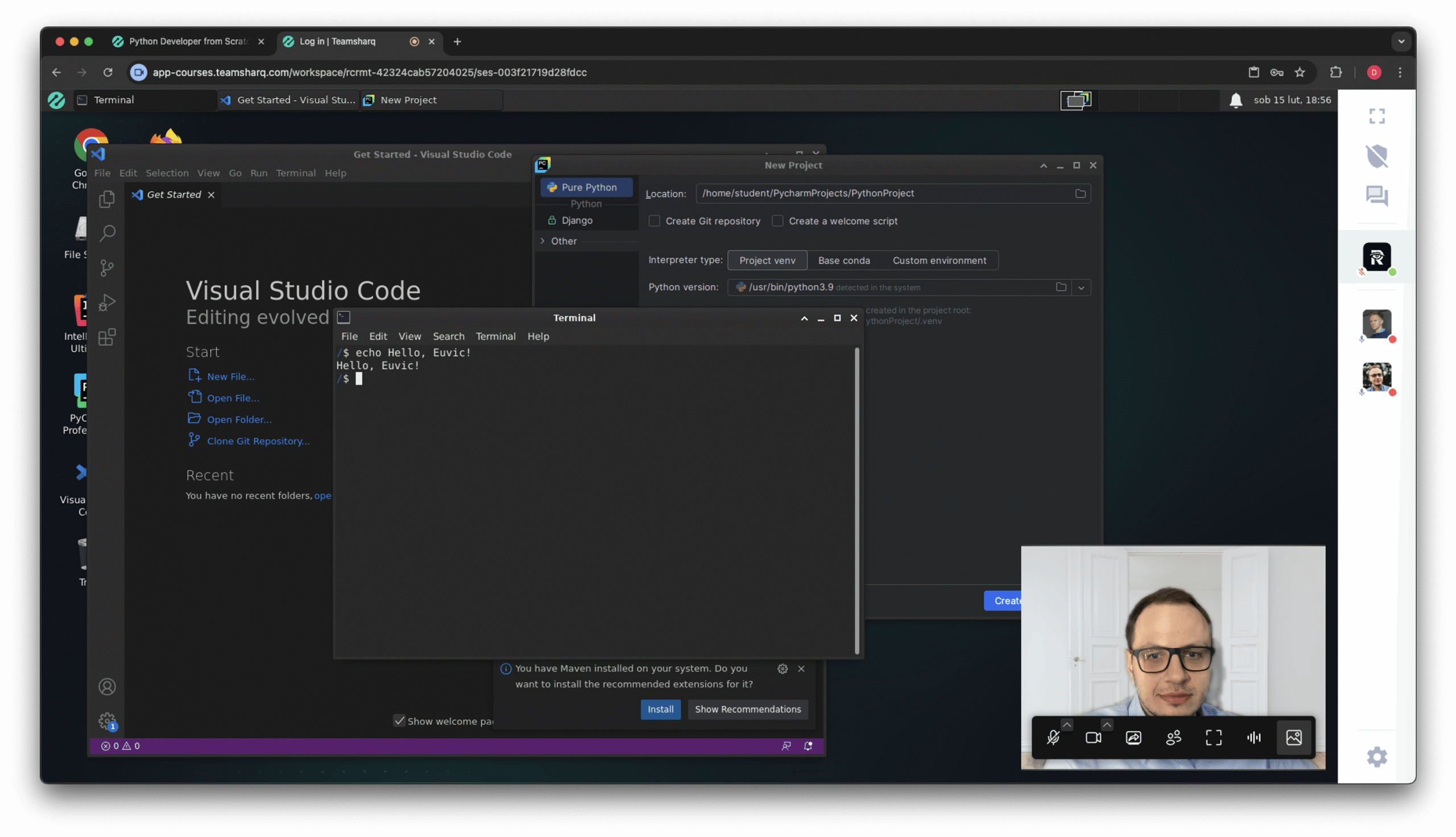
Linux Workspace inside the browser
How many clients do you have and where are you seeing the biggest interest?
Nordea Bank, Commerzbank, EY Academy of Business, ERGO Hestia, infoShare Academy, Gdańsk University of Technology and others across banking, insurance, IT services and training companies – primarily in Poland.
The UK is the market we’re most actively entering. Not only because of its size, but because a client in an English-speaking market travels everywhere – a UK reference opens doors in Australia, Canada, the US and across Europe in a way a Polish reference simply doesn’t. We’re also in advanced discussions with one of Poland’s largest training providers about a deployment at a scale we haven’t operated before.
What do you hope Teamsharq looks like in five years?
Every training session delivered on Teamsharq should have an AI mentor running alongside the learner inside the environment — an agent that can see what they’re doing in real time, intervene before they know they’re stuck and hand control back once they’re on track. Not a chatbot outside the experience. An active participant inside it.
Alongside that, we’re building two infrastructure layers that solve the problems stopping enterprises from adopting AI in training at all.
The first is API capturing. Learners already use tools like Copilot and ChatGPT in their daily work — so we intercept those familiar interfaces and route the requests to our own models running inside the isolated environment. The learner sees the tool they already know. The query never leaves the training infrastructure. And instead of paying per token — where a single curious employee can accidentally burn through hundreds of euros in a morning — the organisation pays a single, fixed price. No surprises, no usage anxiety, no one rationing their questions because they’re worried about the bill.
The second is locally-hosted open-source models, where we run models directly inside containers with GPU passthrough on ours or the client’s infrastructure. One model loads once per server and serves many concurrent learners simultaneously — making the economics work in a way that hasn’t been viable before. The learner opens their environment and has a capable AI assistant. Nothing was sent anywhere. Nothing was billed per word.
Together, these two layers solve the two problems that stop enterprise organisations from adopting AI in training: cost unpredictability and data risk. One fixed price. Zero data leaving the building.
As a business: the default infrastructure for software-based training, globally. Not the most visible EdTech brand — the most essential layer. The thing that runs underneath and never breaks.
Fifteen years ago, almost every VC jumped into MOOCs — video course platforms such as Coursera, edX and Udemy. But they don’t work. They never have (according to Science Magazine). If you want to learn something, you want to do it on your own use cases. A combination of our environments, open-source AI models in containers, API capturing and local AI agents might finally be the final frontier of software-based education. Don’t get me wrong — AI will not replace the human instructor. But imagine a large organisation with an internal academy that can equip each of its employees with a 1-on-1 AI mentor that can not only suggest steps but take control of the tools — in a secure, isolated environment, at a fixed cost, with data that never leaves the company. In the corporate world: less risk = more profit. Even with the upskilling.
What was the most valuable thing you took from the StartupYard programme?
We believe StartupYard was the exact catalyst we needed to transition from a regional player to a global contender. In enterprise B2B, especially within highly regulated industries, you don’t scale globally just by having superior technology – you scale through trust, relationships and deep market-entry mechanics. The programme helped us rethink our approach to international expansion. It also helped us surround ourselves with people who are far more business-savvy and experienced than we are. And that’s the most crucial benefit for us.
PS: We want more. 🙂