
What is Good Storytelling? (Part 1)
First: What is Storytelling?
There’s no single compact definition that can cover every modern use of the word “story.” You may think of news articles, or children’s fairy tales. You may think of “user stories,” that product designers use to figure out what to build. You may think of a novel. In fact, most stories have common characteristics: characters, settings, plot, conflict, and an ending.
But in talking about a “brand story,” or a “cultural story,” or a “life story,” we are really discussing a specific kind of story: the “Mono-myth,” also commonly known as a “Hero’s Journey.” At the heart of what we call “storytelling” in the modern world, you find this core structure:

The world’s oldest documented story is The Epic of Gilgamesh, written 4000 years ago on clay tablets. It’s the story of Gilgamesh, a God King of the Sumerian state of Uruk. He begins as a restless and foolish young man, who leaves his city behind to explore the world, faces many challenges, becomes wise, and returns home a hero, ready to lead his people.
That ought to sound familiar. It’s the basis of every epic story from the Odyssey to Star Wars.
The Hero’s Journey works incredibly well at persuading audiences because it is a simple and flexible vehicle for conveying the human experience. It speaks to us about our experiences in life, by recreating those experiences, only with more flair, more danger, and bigger stakes.
The Hero’s Journey
Pick a big successful brand at random. Recall what you can about their “story.”
Chances are excellent that it is a “Hero’s Journey,” following the same pattern laid out 4 millennia ago in Gilgamesh. McDonalds has its Ray Krok, Apple has its Steve Jobs, and Microsoft its Bill Gates.
Not coincidentally, there are movies about all these characters, and they are all Hero’s Journey movies. The appeal of this story is so great that it is virtually synonymous with storytelling in film.
Within each of these stories is a familiar narrative: a misfit, naive and ambitious, confronts a cruel world, fails, grows, and finally succeeds. That is the simple core of every human story, and thus, every company story as well.
Qualities of a Great Story
Now we know what a story looks like. So which are the specific qualities of a really strong story? What makes this overall structure work best? Here are a few things I think are essential in a good story:
Great Stories Have Human (imperfect) Characters
Great stories appeal to the listener by being, essentially, about human nature. Great heroes are appealing because of their humanity, and not because of their power.
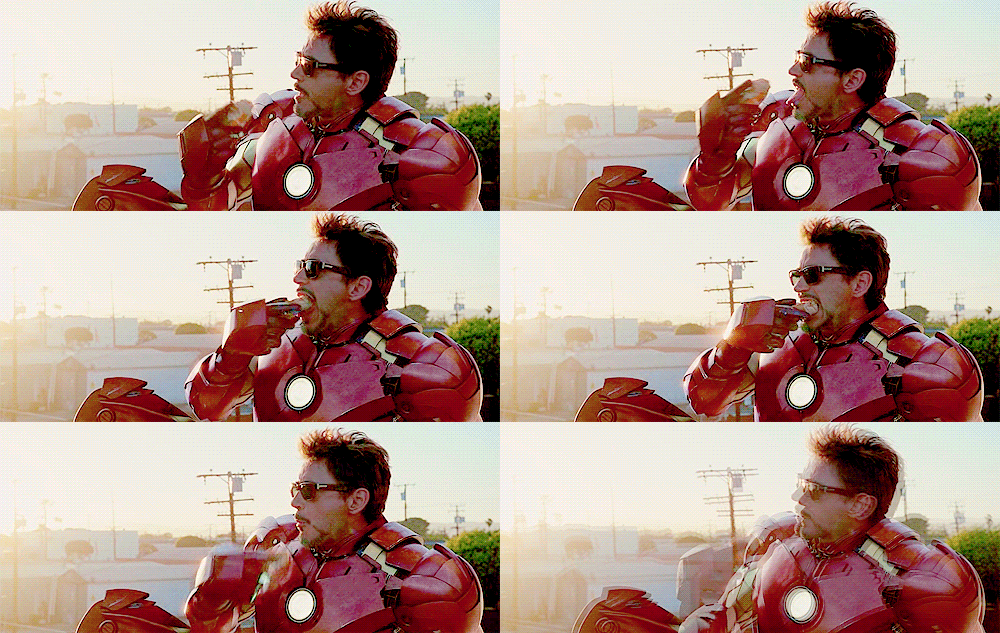
The 2010’s Most Popular Hero
Think about why people love Batman, or Iron Man: it’s because they are flawed human beings. It is the human experience to face moral tests and temptation. Thus, a story in which good and evil are too easy to separate is a story without any moral tension.
For Example:
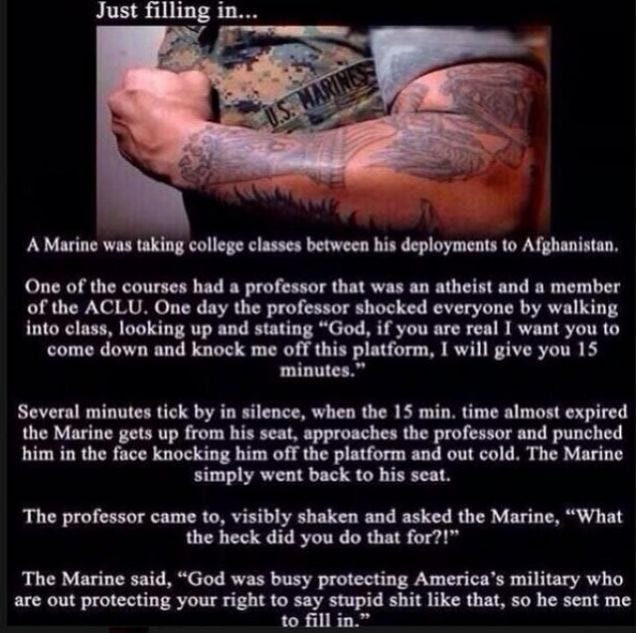
You may have at some point spotted this meme making the rounds on Facebook. It’s got enormous viral potential, which is why it has been shared so widely (by both those who find it hilarious, and those who take it seriously)
It’s also a great example of bad storytelling.
In this story, we are presented with two characters in conflict: one entirely sympathetic and brave, the other entirely unsympathetic and cowardly. Thus, the point of the story, or the moral, is never in doubt. While the story creates suspense by making it unclear exactly what will happen, it creates no suspense over what the story thinks should happen.
No one in the story learns anything. No one changes as a person. One wins, and the other loses, but nothing is different at the end.
Great Stories Are About Change
I attended a panel on startups by the renowned actor Kevin Spacey this past weekend. One phrase above all stuck out to me as an example of how he sees storytelling. When asking a founder a question about his motivations in business, the founder responded: “Well, that’s complex.” To which Spacey responded: “Go ahead. Be complex.”
People are complex. So stories must also deal in moral complexity. They must give the heros and the villains an “arc.” As in Gilgamesh (or any epic story), the hero must fail to become wise. A villain must experience pride before the fall. Otherwise, nothing has changed.
Take, for example, this highly compelling commercial from none other than Budweiser, simultaneously America’s best selling, and worst tasting beer:
This is practically the definition of a Hero’s Journey. A young man with a romantic vision leaves home, only to find that the world is harsher than he expected. Enduring many trials, he finds help in unexpected places (the black man on the river boat). Having grown through his experience, he reaches his new home ready to accomplish great works: in this case, brewing beer.
This ad was seen as shockingly political (released weeks after the 2016 US Presidential Election), but it was also very successful. And that is because it is a real story, not just an ad.
It seeks to reframe the story of Budweiser, “America’s Beer,” into the story of Americans themselves, where they come from, and what they should believe in.
It also presents a coherent moral argument: that adversity makes us stronger, and that perseverance leads to success.
Importantly, neither of the two main characters in the story (America, and Budweiser himself), are either purely good or evil. Budweiser shows hints of arrogance from the beginning, before becoming wiser, and America shows signs of openness, even after initially seeming a cruel place indeed.
The story is about these characters changing together.
Great Stories Are About Conflict
As we’ve now seen, conflict is essential to a powerful story.
Conflicts in stories boil down to need. Human beings and societies have competing needs. How those needs are addressed, and which needs win out over others, are key elements of a story.
Convincing an audience that one need is greater than another is vital. Otherwise, why should a person pay attention to your story? It involves no consequences.
This is a video I often use to talk about bad storytelling. It’s a coca-cola ad from the early 1980s, when Coke was getting its ass kicked by Pepsi’s brilliant marketing.
But what’s not to love? Sunny day, happy people, soccer for some reason, and everyone having a “Coke and a smile.”
This ad was a failure, along with much of Coca-Cola’s marketing at the time. There is zero conflict in this story. And because there is no conflict, there is no identification of any urgent need. Do I need to have a coke on a nice day? It seems these people are having fun, regardless of what they’re drinking.
Brands routinely fail to introduce real conflict into their product and brand stories. Here’s a more recent example:
There’s a lot wrong with this ad, but the most important problem is that the conflict it presents is false. We see trials and struggles for the hero, but we are told at the end that there is no solution. And instead we should just buy a car. It’s insulting.
Cowardly marketing and bad storytelling happen when we refuse to acknowledge that our customers are people with their own problems. They aren’t just people out in a park having a perfect day, ready to jump at the chance to buy a coke.
They won’t automatically feel better about themselves just because someone tells them it’s ok to buy a car. Even if that car is the best car ever. They have other needs as well- more important ones.
Coke actually learned that lesson. Here is a typical ad from more recent years:
Here is conflict. Suspense! Competing needs and wants. And the brand in the story is associated with wisdom, with the setting aside of personal enmities in favor of love.
That’s a great story to tell. It appeals to people as they are: always in conflict with themselves, and always unsure of what is right.
Creating and Resolving Conflict
How do you make your story real to other people? You do it by making the conflict real to them. By showing them how the conflict in your story should matter to them.
This is also where a lot of startup stories fall apart. They make the mistake of thinking that making a good argument is the same as actually persuading someone. But it is never enough to just be right. The person has to believe you’re right.
In the next post in this series, I’m going to talk about how to identify parts of your story, as a founder, as a company, or as a person, and bring out the hidden conflicts that will help you relate that story, and make it matter to other people.