
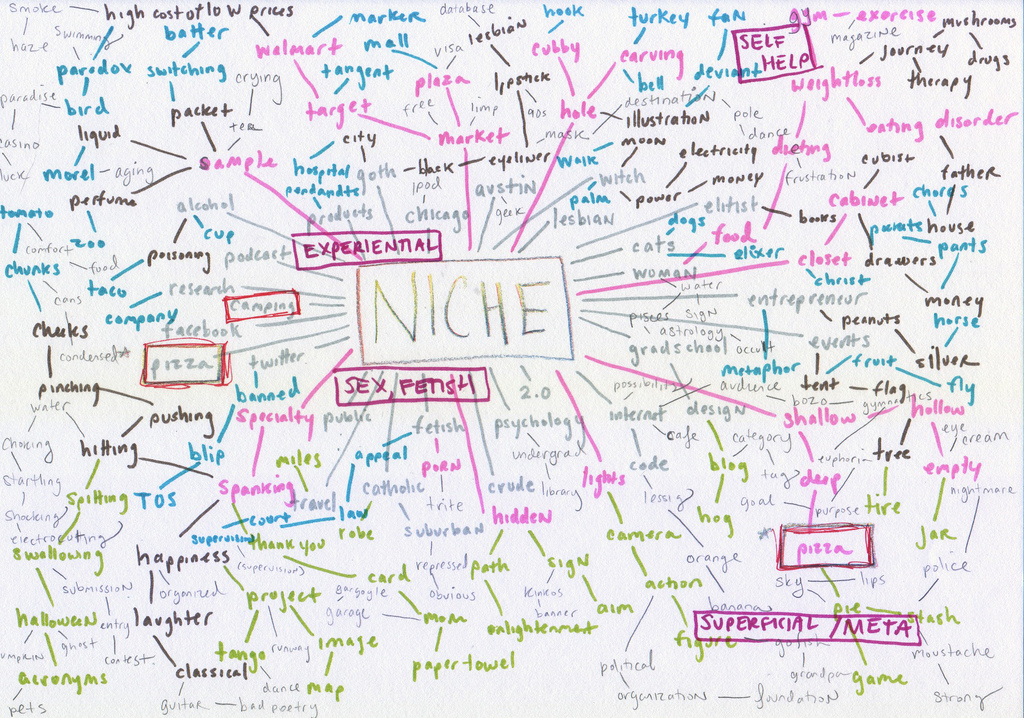
Where Are you Dumping All your Beautiful Thoughts?
If you’re anything like me, you probably have a journal or two sitting around somewhere, with your name scrawled on the inside cover, and one or two hopeful entries, followed by an embarrassing, plaintive emptiness. If you’re good at documenting and privately reflecting on your own thoughts as a life habit, then I applaud you. I’m not good at it. In fact, I often resort to looking up my old notes on Facebook, or private messages and emails I’ve sent, to try and capture thoughts I once had, that are now gone.

Dear diary, I have been at the accelerator for 3 months. I am beginning to recognize in the natives, a gentle beauty.
I’m not writing to tell you that you should be a better person and write your precious, heartbreaking insights in a journal, just like Kevin Costner in Dances with Wolves. Of course you should, but I can’t make you do it. I can’t make myself do it.
But Mindmapping is different, and you should give it a try. This post is going to be about the why and the how of mindmapping. So let’s get started, shall we?
Step 1: Brain Dump
Cedric calls mindmapping “a braindump.” I rather like that analogy, so I’ll use it here. It’s a messy, minimally organized process into which you can just spit out all the flotsam of your thoughts and ideas. It can show you what you’re thinking about, help you to start prioritizing your objectives, and remind you, as you reach for higher levels of organization, what you were thinking about at the beginning. It can be a benchmark of the evolution of your idea from “idea,” to “actual workable plan/strategy/concept.”
And contrary to what many people think, even and often especially the smartest among us, an idea is just an idea, and usually not very valuable, until it’s been through a couple of processes like this one. Mindmapping helps you to challenge yourself and your ideas to define themselves in ways that aren’t conveniently hazy, but are also not overly strict or structured.
It can start by simply writing down, with no structure attached, any and all thoughts or elements attached to the goal. This is the brain dump. You could write down dates, people’s names, places, quotes- whatever you think is relevant. This is a map of your brain, so whatever comes into your head can be written down. This is not the stage where you need to be picky about what it all means, nor what’s really relevant.
Step 2: Contextualize and Problematize
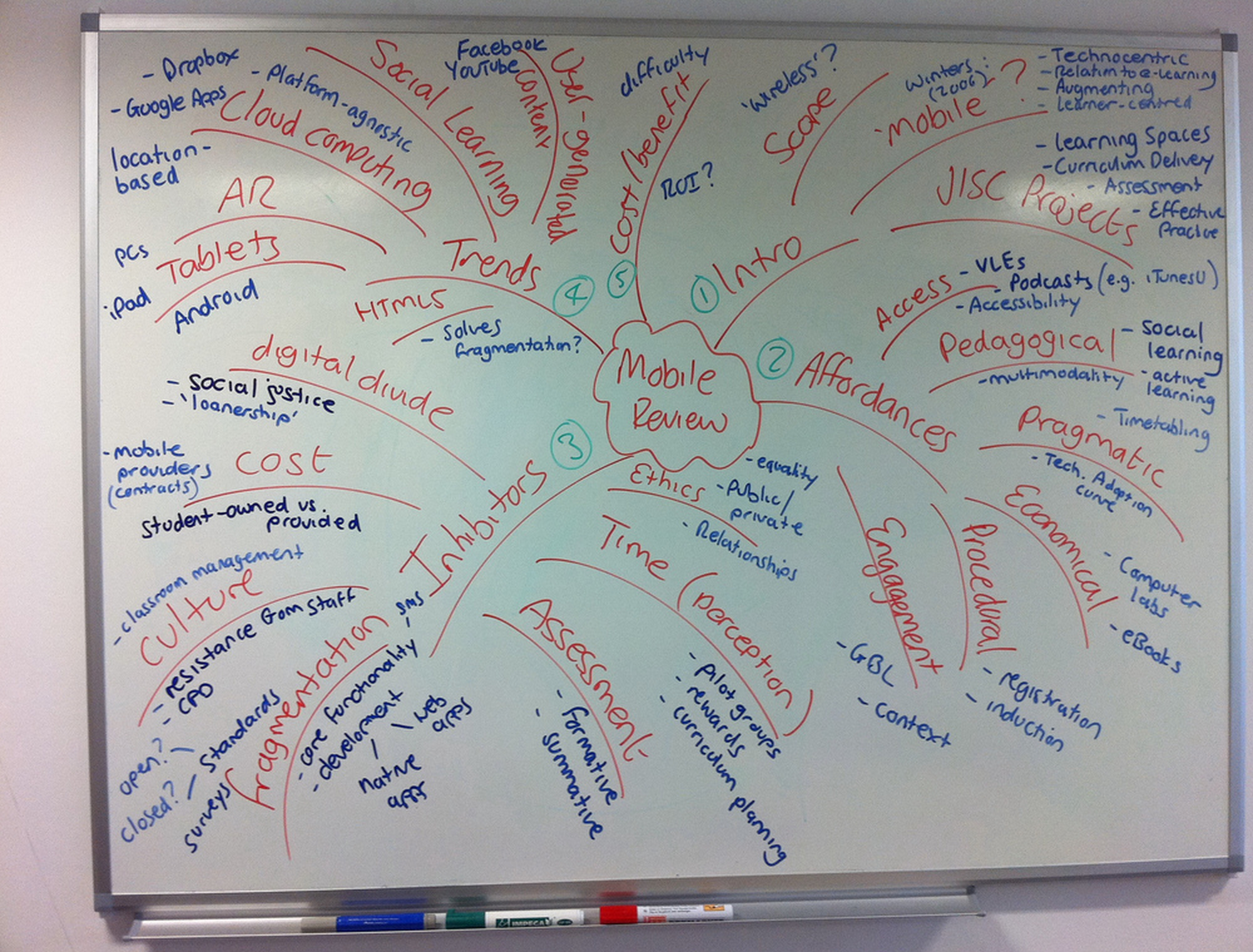
Photo: Doug Belshaw, Flickr
I have a friend who’s been about to write a screenplay for the last 8 years. He has the perfect idea, he says. But when he tries to put it on paper, it doesn’t seem to work.
And here’s why that is: because he has never contextualized and problematized his idea. What does it mean to contextualize and problematize? This is the step in the creative process that forces you to take all those gooey bits of information floating around in your head, and make them stick together in some sort of a cohesive fashion. It is creating a context for your ideas: to see how they all fit together, and to possibly see what’s missing. It’s the part of the process where you address how your ideas may be stronger or weaker, depending on other factors.
Once you have all this crap written down and out of your head, you’re ready to start working. The next step is to connect these bits of information to each other in some way. You could use clouds, lists, trees of information. It doesn’t matter: whatever fits your thinking will work. You can re-draw the mindmap with a little more organization to “make it pretty,” if that’s something that pleases you.
Challenge Yourself
Context means the bigger picture- and the bigger picture involves the negatives along with the positives. What’s wrong with your idea? What issues do you face in implementing it? Problematize as many elements of your mindmap as you can, and challenge all the elements that you think are necessary to make the project work. If you need something to happen, find reasons why it might not. If you need something not to happen, look for reasons that it could.
This is the stage of the process where you may discover a project is too big to do in the time you’ve given yourself to complete it. Or to find out you don’t know enough to do the work, or that your idea for a product is already essentially being done by somebody else. This is the part of the process where your “beautiful thoughts,” the picture perfect dream you have for your ideas, are mired in the messy realities that you don’t normally make yourself face. It’s a reality check.

Photo: smemon Flickr
This stage of the process is the least fun. It doesn’t feel productive because it is energy spent challenging the assumptions that you are using to tell yourself that your idea will work. But as we know, many or even most ideas never do actually work out. You can find this out here, and get a realistic idea of the challenges you face while doing so.
Step 3: Analyze
This is a reflective step. Using the information you’ve gathered so far, make some educated guesses about how likely your goals are to be realizable, given the current circumstances. How likely are circumstances to change? Do you even want to keep working on this project? If so, what reasons can you give for others to invest time and money in it?
A typical analysis tool for a business or a product is called a SWOT analysis. It forces consideration of 4 interconnected factors: Strengths, Weaknesses, Opportunities, and Threats. It looks something like this:

In this step, you can gather all that you’ve learned, and diagram it according to the positive and negative, the internal, and the external. This could be called the honesty phase. A frank assessment of the situation and the options.
We are human beings: we naturally oscilate between an extreme focus on our strengths, when we are selling them (to ourselves or to others), and on our weaknesses, when something isn’t working. We do the same with opportunities and threats. But we rarely if ever consider our strengths directly against our weaknesses- even if doing so can provide invaluable insights. So adopt a process that makes you consider these things together.
Step 4: Synthesize
We wrote a while back about how the groundwork you do at the beginning, from day one on your odyssey towards profitability, should start with your pitch. Mindmapping is part of that same iterative process, and the fruits of a good mindmap are fodder for a great pitch. What you know now about your market, your product, your customers, and your own abilities, will translate into a persuasive argument for your viability (if you’ve decided you are viable).
If you’ve dumped out all your valuable ideas, contextualized and problematized them, and analyzed them honestly, assessing your options, you’ll be able to answer most questions a potential investor or a client asks of you, even before the question is asked. You’ll be aware, and more importantly unafraid, of the challenges you face.
Wishful thinking and hubris are the enemies of a persuasive pitch, and a viable product idea, and mindmapping can keep you honest, keep you thinking, and keep you solving problems, instead of ignoring them.
[ssba]